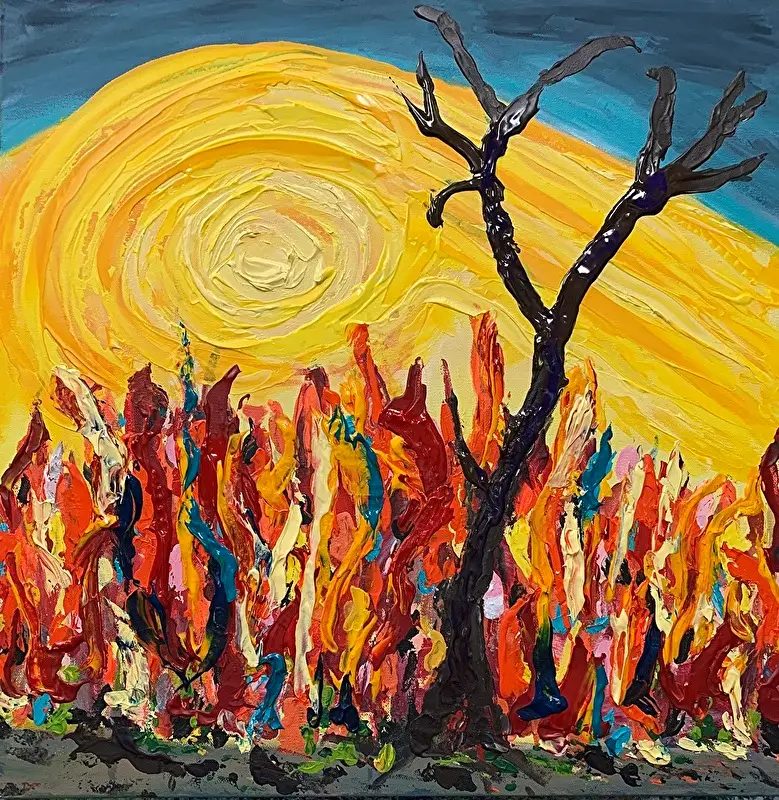
114 Degrees Fahrenheit
The painting above serves as a poignant reminder of how our disregard for scientific information about climate change has contributed to rising temperatures and the destruction of homes and forests.
This week’s reflection comes from a place of both urgency and hope.
Al Gore once said, “Political will is a renewable resource.” He was speaking about our collective power in a democracy to act-especially in the face of the climate crisis. When we unite around shared values, we can transform systems. The potential is there. We just have to tap it.
This idea echoes a Unitarian Universalist principle I embraced in my youth:
“Respect for the interdependent web of all existence of which we are a part.” It’s a beautiful reminder that we are not isolated beings. We are part of a vast, delicate network of people, ecosystems, histories, and futures. The way we treat the planet and one another matters deeply.
Why This Matters to Me
Interdependence:
Every action ripples. Even small ones. Dropping a tissue on the road may seem harmless, but it could contribute to pollution or spread disease. A single careless moment can reverberate in ways we don’t immediately see.
Environmental Reality:
Years ago, I traveled up the Dnieper River in Ukraine and saw people fishing in a thick, algae-covered, foul-smelling current. It broke my heart. That catch might have been the only food some families had. Sadly, similar conditions exist here in the U.S., where fish runs are disappearing and clean water is no longer a given. All living creatures have a right to unpolluted water, food, and air needed to stay alive. We survive together, or not at all.
Social Justice:
As a child, I learned about immigrants who built this country-Pilgrims fleeing persecution, Irish families escaping famine, African slaves picking cotton, and Chinese laborers laying tracks across the West. Many were met with hostility, despite their contributions. Their hurt stays with me, along with the good they brought to the melting pot experiment we call the United States. We may look different, but beneath our skin we share the same blood, bones, and dreams. How we treat one another shapes who we become as a society.
Beyond Individualism:
We are social beings. I once saw a music teacher form a high school jazz band filled with prodigies. Each student was gifted, but when the group first came together, it was a chaotic scene. Only when they stopped trying to outshine each other and started listening to the conductor did they create something beautiful. Harmony overcame ego, and community became more important than self.
The principle, a respect for the interdependent web, is more than a belief. It’s a way of being.
It is a constant reminder that our fates are woven together, that no action is too small, and that we each hold a thread in the tapestry of change. It’s what gives me hope, even in difficult times. If political will is renewable, then our compassion, courage, and collective strength are, too.
I’d love to hear from you:
Have you had a moment that reminded you we’re all connected?
Share your story on my Blog Site—or forward this to a friend who might need a little hope today.
Until next time,
Marilynne
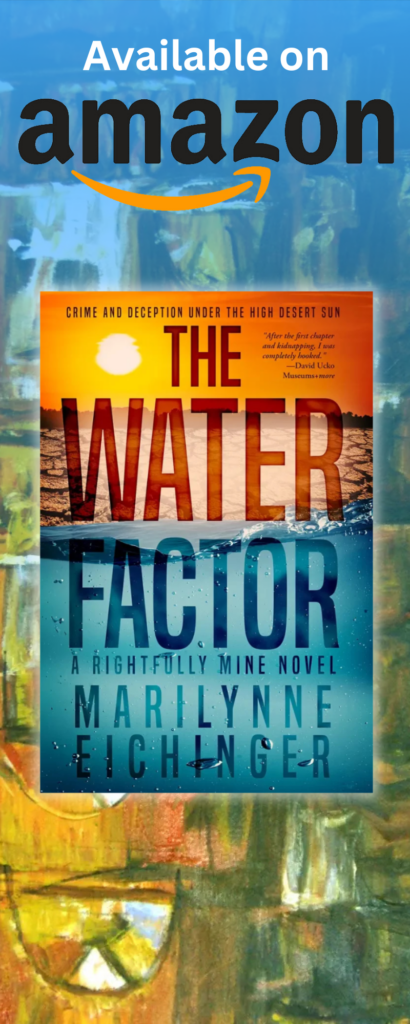
The Water Factor is a Firebird International Award winner for best dystopian novel and a Literary Titan recipient for best thriller. It is available in ebook, paperback, and audio formats. It can be purchased on AMAZON, Barnes and Noble, and as an audiobook on Amazon, Audible, and iTunes. Ask your bookstore to order a copy from Ingram. Please leave a review.
My art is always for sale. I painted 114 Degrees Fahrenheit during an intolerable heat wave two years ago. I ran to my studio with sweat dripping from my forehead, compelled to capture the feeling that I, too, was burning up. You can purchase directly from my site, FAHRENHEIT, or contact me at marilynne@eichingerfineart.com
Blog site
https://www.eichingerfineart.com/blog/201972/political-will-and-the-independent-web-of-life
XXXXXXX a mailchimp version.
Political Will and the Interdependent Web of Life
“Political will is a renewable resource.” – Al Gore
That quote sticks with me. Why? Because it’s a reminder that our shared willpower—the energy to change systems and protect our planet—is not finite. It grows when we act together.
It also reminds me of a Unitarian Universalist principle I’ve carried with me since my youth:
“Respect for the interdependent web of all existence of which we are a part.”
This belief helps me navigate the world with more care, humility, and hope.
🧵 What This Looks Like in Real Life
💧 Interdependence
Even something as small as tossing a tissue on the ground creates ripple effects—pollution, germs, a disregard for our shared environment. Every action matters.
🐟 Environmental Wake-Up Call
I once traveled up the Dnieper River in Ukraine and saw families fishing in a foul, algae-choked current. That water was toxic, but they had no choice.
I see echoes of that here in the U.S.—where fish runs are disappearing, and clean water is becoming less certain. We survive together—or not at all.
🫶 Justice and Connection
As a child, I learned about immigrants who built this country—Pilgrims, the Irish during the Potato Famine, Chinese railroad workers. Many faced cruel treatment despite their sacrifices.
Their stories shaped my values. Beneath our differences, we share the same blood, bones, and dreams.
🎷 The Jazz Band Lesson
A teacher formed a jazz band full of talented high school musicians. But instead of music, they created noise—everyone soloing, no one listening.
Only when they slowed down and learned to play with one another did the music emerge. Harmony requires collaboration.
🌱 Why I Keep Writing
The interdependent web isn’t just poetic—it’s deeply practical. It reminds me that every choice has meaning, and every person has a role.
If political will is a renewable resource, then so is our compassion, our resilience, and our sense of shared purpose.
Let’s keep renewing them.
💬 I’d love to hear from you:
Have you had a moment that reminded you we’re all connected?
Just hit reply and share your story—or forward this to a friend who might need a little hope today.
Until next time,
🌾 [Your Name]
[Share this Newsletter] | [Forward to a Friend] | [Subscribe Here]
XXXXX
Interdependent Web and the Renewable Resource of Political Will
Al Gore famously said, “Political will is a renewable resource.” He emphasized that democratic systems can amplify our ability to take action on the climate crisis—and that, by coming together, we can drive meaningful change.
This idea echoes a Unitarian Universalist principle I embraced as a young woman: “Respect for the interdependent web of all existence of which we are a part.” It’s a principle that emphasizes our profound connection to the environment—and to each other. It calls us to recognize that our actions ripple outward and that we bear responsibility not only for ourselves, but for the entire living world.
Yet this idea goes beyond environmentalism. It warns against the dangers of unchecked individualism and systemic oppression. It speaks to the balance between personal freedom and collective well-being, reminding us that no one truly thrives unless we all do. We are woven into each other’s fates.
Interdependence in Action
I think of this web every time I act, even in small ways. If I toss a tissue on the ground, it’s not just litter—it could carry germs, feed rats, clog drains, or, in a worst-case scenario, contribute to public health risks. Every careless act has consequences.
The concept also became vivid for me while traveling up the Dnieper River in Ukraine. I saw families fishing in foul, algae-choked waters—among the most polluted I’d ever seen. They had no other source of food. That moment underscored the human cost of environmental neglect. I couldn’t help but think of communities here in the U.S. where fish runs have dwindled and clean water is no longer a guarantee. Water is not a luxury; it is a right.
Justice and Belonging
The interdependent web also shapes my view of social justice. As a child, I was raised with a deep belief in fairness and compassion. I learned about the Pilgrims fleeing religious persecution, the Irish who escaped famine, and Chinese laborers who built the railroads—people whose contributions were essential to America’s growth but who were often met with cruelty.
What struck me then—and still moves me now—is that our shared humanity transcends differences in appearance or origin. Beyond the melanin in our skin, we all have the same blood, bones, and breath. We belong to one another, whether we act like it or not.
Beyond Individualism
While individuality is important, excessive individualism can become toxic. We weren’t built to go it alone. We thrive in community, in relationships, in shared purpose.
I once watched this lesson unfold through music. A teacher at an affluent high school formed a jazz band, assuming that the students—many of whom had years of private lessons—would naturally sync. Instead, chaos ensued. Each student was too busy showcasing their talent to listen to the others. It wasn’t until the teacher brought them back to basics—teaching them to listen and harmonize—that they began to make music. By year’s end, their concerts were a joy to behold.
The lesson? We don’t succeed just by being talented individuals. We succeed by learning to work together.
The interdependent web is more than a metaphor. It’s a way of seeing the world that grounds me in both humility and hope. It challenges me to notice how my smallest choices matter and to believe that change is possible when we act together. Political will, like a renewable resource, grows when we tap into our shared purpose—and when we remember that none of us are separate from the whole.
XXXXXX
Al Gore famously said, “Political will is a renewable resource.” He emphasized that democratic systems can enhance the capacity to mobilize action addressing the climate crisis. And that by coming together, we can foster effective change.
A Unitarian principle that I embraced as a young woman tells us to have “Respect for the interdependent web of all existence of which we are a part.” It emphasizes the interconnectedness of all living things in the environment, encouraging a sense of responsibility towards the planet and all its inhabitants.
Upon closer examination, the statement extends beyond an environmental focus by addressing the dangers of individualism and oppression. It promotes a balance between individual and collective needs we are interconnected and therefore dependent upon one another.
What it means to me and how it affects my life is better understood when I delve deeper into the statement.
- Interdependence: Since everything is connected and the actions I take have consequences for the whole ecosystem. If I throw a Kleenex on the road, not only will it make the roadway look trashy, but it could also spread germs that may be the start of the next pandemic.
- Environmental Focus: Caring for the Earth and all its creatures is important for survival. We stay alive together or not at all. When I traveled up the Dnieper River in Ukraine, I saw people fishing in what was the most polluted, algae-topped, smelly waterway I had ever traveled on. I felt so sorry for the families that rely on the day’s catch. This is occurring in our own country, where fish runs have dwindled. Clean water is a precious right needed by all living things.
- Social Justice: I find peace by embracing the interconnectedness of all people. Justice, equity, and compassion have been embedded in my psyche since I was a child learning in school what America stands for. I studied the Pilgrims and why they left Europe, learned about the Potato Famine in Ireland, and the poverty in China that brought men to the West Coast to build the railroads. That we didn’t always treat these immigrants well saddened me, for they were what made America great. How we act and speak to one another matters. Aside from the melanine in our skin, were have the same blood, muscles, and bones that will one day feed the earth.
- Beyond Individualism: Though individuals are important, I find a danger in excessive individualism. Our forefathers revolted against King George for the unfair practices levied on ordinary people. We are a social species that thrives by belonging to something larger than ourselves. I learned early through music that the whole is greater than the sum of its individual parts. A teacher organized a high school jazz band in an affluent neighborhood where children had private music lessons since childhood. With such accomplished student musicians, he thought all they had to do was come together to play and improvise. Instead of music, however, he would up with bedlam. He had to take the group back to basics, teaching them to play harmoniously before they could add their individual expressions. By year’s end, their performances were well attended.
- The interdependent web of life is more than a scientific truth. It provides a source of meaning and purpose, and encourages individuals to dedicate themselves to looking beyond the obvious in their daily actions. It is what gives me hope and motivation—that together we can solve problems. Each person’s difficulties and actions have ramifications affecting the greater society.