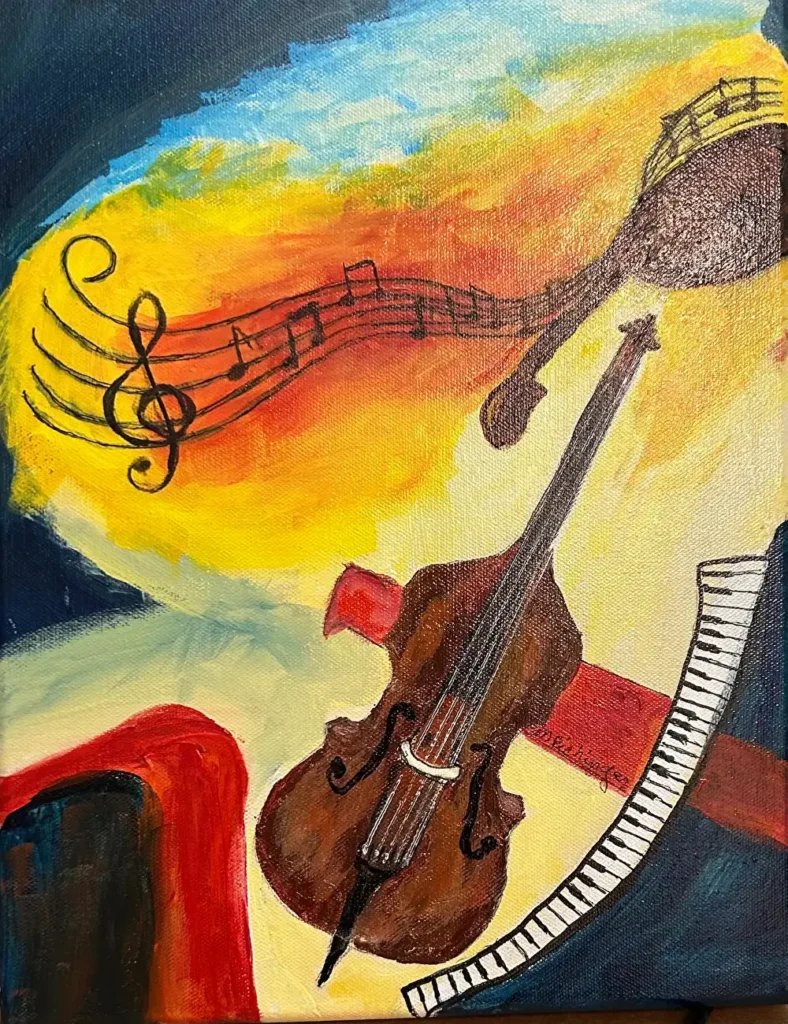
Curtain’s Up
Music and painting have a way of lifting our spirits and uniting us. They pull back the curtains separating people and soften the differences that weigh us down.
The Puritans came to the New World seeking religious freedom from the Church of England, which they believed had not gone far enough in breaking from Catholicism and still retained too many “Popish” rituals. They founded what became the Congregationalist tradition, grounded in the belief that churches should be autonomous, self-governing communities of worshipers. Christ, not bishops, was the ultimate authority.
Their faith rested on Calvinist doctrine, including predestination: the belief that God had already determined who would be saved and who would be damned, independent of human merit. This worldview demanded strict moral behavior and absolute obedience to scripture. While it offered certainty, it left little room for individual conscience or spiritual flexibility.
By the early 1800s, a reformed branch of Congregationalism emerged in response to a rapidly changing world shaped by industrial capitalism, scientific discovery, and social upheaval. This movement eventually broke away to form Unitarianism, which emphasized internal spiritual principles rather than miracles as the foundation of conscience. Unitarians believed each person could connect directly with the spiritual world and that every soul possessed inherent worth, without a division between the saved and the damned.
The Congregationalists established Harvard College to educate ministers and civic leaders with a Calvinist foundation. Over time, however, Harvard’s curriculum grew more liberal, shifting toward Unitarian thought and emphasizing reason, intellect, and moral philosophy. Many of these early Unitarians were drawn to a philosophical and literary movement gaining traction in Europe: Transcendentalism.
The term “transcendental” traces back to Immanuel Kant’s Critique of Practical Reason (1788), which explored how moral knowledge arises from human reason and inner experience. In America, the movement took shape in the 1830s, notably after a meeting at Harvard’s Bicentennial celebration in 1836 attended by Ralph Waldo Emerson and Henry David Thoreau.
Transcendentalists believed in individualism, self-reliance, and direct spiritual experience. They saw nature as a primary source of truth and rejected rigid doctrines that reinforced social hierarchy and materialism. What stayed with me from transcendentalist writing was the idea that freedom of thought was necessary if people were to live honestly.
Crucially, transcendentalists extended this belief beyond the privileged. They recognized the enslaved, the imprisoned, and the mentally and physically challenged as full members of society, entitled to equal spiritual and moral consideration. Personal liberty, in their view, was inseparable from social justice.
These ideas spread throughout the young nation, shaping both its literature and its politics. Emerson’s essays challenged conformity and urged moral independence. Thoreau’s Walden and later Civil Disobedience championed simplicity, nonconformity, and ethical resistance. The movement also drew figures such as Nathaniel Hawthorne, Louisa May Alcott, Elizabeth Peabody—who pioneered the kindergarten movement in the United States—and Margaret Fuller, a leading advocate for women’s rights.
Several U.S. presidents were directly connected to Unitarian or transcendentalist thought. John Adams moved from Congregationalism toward Unitarianism, rejecting the divinity of Christ as incompatible with reason. His son, John Quincy Adams, helped found the First Unitarian Church of Washington, D.C. Millard Fillmore was a longtime member of a Unitarian congregation in Buffalo, and William Howard Taft openly identified as Unitarian and supported the American Unitarian Association.
Other presidents, while not formally affiliated, reflected transcendentalist ideals in their thinking. Thomas Jefferson championed intellectual freedom and the pursuit of knowledge. James Madison emphasized personal conscience and moral responsibility. Abraham Lincoln’s focus on self-reliance and ethical duty echoes transcendentalist influence, as does Rutherford B. Hayes’s commitment to education and social reform.
I was not raised in a Unitarian household, but growing up on the East Coast meant absorbing many of these ideas almost by osmosis. I still hold them close. I remember classrooms where questioning was encouraged. and dinner-table discussions where disagreements livened the conversation. I looked to science and nature for understanding, and I believed in the inherent worth of every human being. Most of all, I’ve learned that deeply held differences don’t have to lead to hatred or fear, and that they don’t have to end the dialogue.
As I move into a new year, transcendental principles feel less like history and more like the world I remember. Empathy, curiosity, and moral courage have long been part of the American experiment. I’ll try to carry them forward in small, ordinary ways; by listening, by questioning, and by resisting the urge to reduce people to labels.
My hope for 2026 is a simple one: more room for thoughtful disagreement, more generosity of spirit, and a renewed faith in our shared humanity. I wish you a peaceful holiday season spent with those you love, and an openness to cherishing the good in one another.
Peer into a transcendentalist heart through Marilynne’s art and books.
Artist website at www.eichingerfineart.com
Author’s website at www.secretsofamuseumjunkie.com
Comment on my blog site at
References:
1) Gura, P. (2012). Transcendentalism and Social Reform. The Gilder Lehrman Institute of American History. Retrieved from https://www.gilderlehrman.org/history-resources/essays/transcendentalism-and-social-reform
2) Cole, P. 19198 Mary Moody Emerson and the Origins of Transcendentlism. Oxford University Press. Retrieved from https://www.theosophical.org/publications/quest-magazine/mary-moody-emerson-and-the-origins-of-transcendentalism?
3)William R. Hutchison, The Transcendental Ministers: Church Reform in the New England Renaissance (New Haven: Yale University Press, 1959), is still the best source for the religious roots of the controversy between younger and older Unitarians.
4) Emerson makes the distinction between the Reason and Understanding in his “Divinity School Address” of 1838. He speaks of the Oversoul in 1841 in the essay by that name.
5) Richard Francis, Fruitlands: The Alcott Family and Their Search for Utopia (New Haven: Yale University Press, 2010).
6) Elizabeth Peabody, “Egotheism, the Atheism of Today” (1858), reprinted in idem., Last Evening with Allston and Other Papers (Boston: D. Lathrop, 1886), 3.
7) Ralph Waldo Emerson to Moncure Daniel Conway, June 6, 1860, in Ralph L. Rusk and Eleanor M. Tilton, Letters of Ralph Waldo Emerson, 10 vols. (New York: Columbia University Press, 1939–1995), 5: 221; and Emerson, Journals and Miscellaneous Notebooks, ed. William H. Gilman, et al., 16 vols. (Cambridge: Harvard University Press, 1960–1982), 14: 352–353.
8) Octavius Brooks Frothingham, Transcendentalism in New England: A History (New York: Putnam, 1876), 331.